
There are places you visit and places that genuinely stop you. Cappadocia belongs to the second category, and I say this having led women through it more than once. Every time, the reaction is the same. The landscape appears and the conversation dies. Not awkwardly. Just because nothing quite prepares you for it, not the photographs, not the travel videos, not even the descriptions of people who have been there.
I want to give you a more honest account of Cappadocia for women, particularly for women travelling together, because there is a lot the standard travel guides leave out. The hot air balloon photographs are everywhere. The Cappadocia underground city, Derinkuyu, is mentioned in most itineraries. But what it actually feels like to be there, and why it lands so differently for women travelling with intention, is a harder thing to find.
This is that account.
The region sits in central Turkey, roughly four hours from the coast by road, and it looks like no other place on earth. Ancient volcanic eruptions deposited layers of soft rock across a wide valley. Over millions of years, wind and rain carved that rock into tall, pointed formations called fairy chimneys, some of them thirty metres high, many of them balanced so improbably that visitors assume they must be man-made.
They are not. Nature made them, entirely on its own, and then the people who came to live here began carving into them. Houses first, then entire towns, then underground cities that descend eight storeys into the earth. Cappadocia is not just a beautiful landscape. It is a landscape that people have been living inside for thousands of years, and that changes how you experience it.
The light is worth a separate mention. In the early morning and at golden hour, the rock turns from beige to amber to a deep, warm ochre. The valleys between the formations shift colour by the hour. If you sit still long enough, you can watch the landscape look like an entirely different place across the course of a single afternoon.
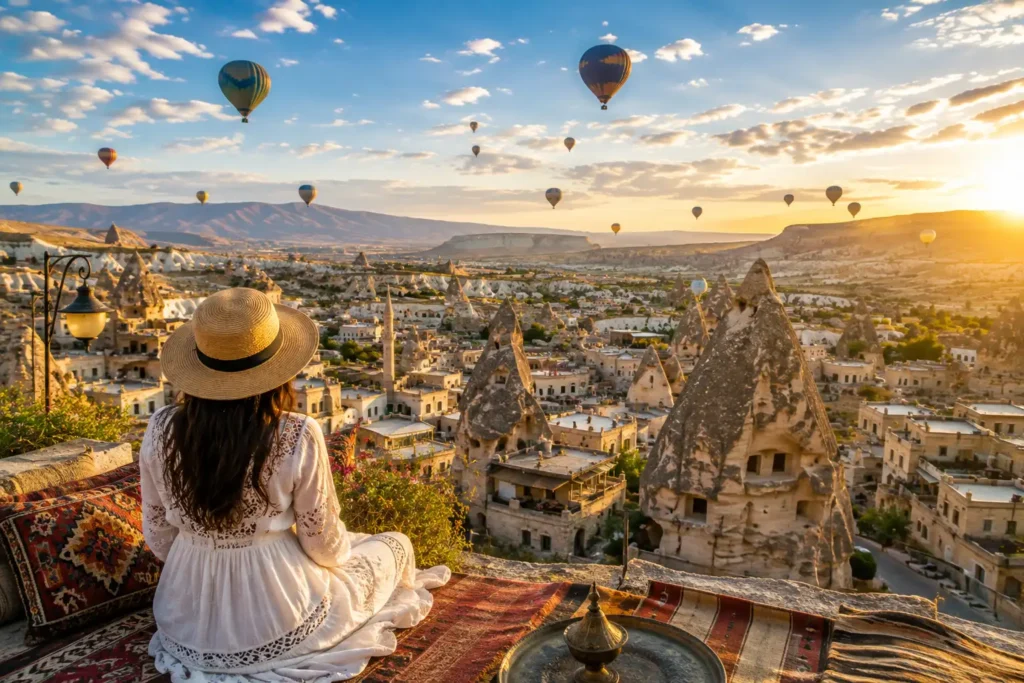
Everyone knows about the hot air balloons. Cappadocia has the most famous balloon scene in the world, with dozens rising every morning above the fairy chimneys, and the photographs are spectacular.
What nobody tells you is what it feels like from inside the basket.
The pre-dawn start is part of it. You are up before four, often still half-asleep, and you drive out to a field where the balloons are being inflated in the dark. The burners make a sound like a contained roar and the balloon swells slowly upward. By the time you step into the basket, the sky is just beginning to show colour.
Then it lifts. And the moment it lifts, completely silently, is the moment that stays.
There is no engine sound, no vibration, nothing. You rise without sensation into the air and suddenly the entire valley is below you, dozens of other balloons around you in the first pink light of morning, the fairy chimneys casting long shadows across the rock. Nobody speaks for the first few minutes. Not on any balloon I have been on.
For women who spend their lives managing noise and responsibility and the constant forward motion of things, that silence is not a small thing. For Cappadocia for women travellers, it can become its own experience, separate from the view.
A practical note: balloon availability is weather-dependent. We have had trips where the balloon went up perfectly, and trips where weather grounded them. We always hold the possibility lightly and treat it as a gift when it happens, not a guarantee. What I can say is that even if the balloon does not fly, Cappadocia at sunrise from the ground is still one of the most beautiful things I have ever seen.
Of all the things we do in Cappadocia, the underground city at Derinkuyu is the one that generates the most conversation afterwards.
Derinkuyu is a city that descends eight storeys underground, carved entirely by hand from soft volcanic rock. At its peak, it sheltered as many as twenty thousand people. It has kitchens, wine cellars, stables, churches, schools, and an air ventilation system that still functions today. The passages are narrow and low in places, and the whole thing was designed to be defended, with large circular stone doors that could be rolled across the corridors to block entry.
People did not live here permanently. Derinkuyu was a place of refuge, used during invasions and raids across a long and turbulent history. Families would descend with their animals and supplies and wait underground until the danger passed, sometimes for weeks.
Walking through it is a strange and absorbing experience. The scale of the engineering is remarkable but it is the human scale of the detail that gets you. The kitchens are sized for actual meals. The sleeping rooms are shaped for actual bodies. The wine press is worn smooth by actual use. Every room was someone’s temporary home, and the whole place carries that weight quietly.
From a women’s travel perspective, I will be honest: the passages can be narrow and some women find the confined spaces challenging. We always mention this before we go in, and nobody is pushed to continue past their comfort level. The majority of our travellers find it completely manageable and deeply compelling. What helps most is going in a small group, unhurried, with a guide who knows the space well. That is always how we do it.
Beyond the balloon and the underground city, Cappadocia offers things that do not make it onto most lists.
The Göreme Open Air Museum is a UNESCO World Heritage site where early Christian communities carved entire churches into the rock and decorated them with Byzantine frescoes. Some of those paintings are twelve hundred years old. They are fading now, slowly, but still vivid enough to stop you.
The pottery town of Avanos sits on the Kizilirmak river and has been producing distinctive red clay pottery for thousands of years, the iron-rich sediment of the river giving it its particular colour. Watching a potter at work is a different kind of stillness from the balloon, but it is stillness nonetheless.
And then there is the valley itself, which rewards anyone willing to walk it. The Rose Valley and Love Valley are accessible on foot, and the scale of them only becomes real once you are inside, looking up at formations that rise forty metres above your head in every direction.
For women who travel to actually be somewhere, rather than simply pass through, Cappadocia for women travellers gives you exactly that. It is slow by nature. It rewards attention. And it is the kind of place where conversations between women who are finally still and present tend to go somewhere real.
Cappadocia is the final destination on our Quest to Turkey 2026, the point the whole journey has been building toward.
By the time we arrive, the group has already spent days together in Istanbul, walked the carpet workshops, and seen the Aegean coast at Kusadasi. Cappadocia is where the pace finally slows completely. We have three days there, which is the right amount. Enough to see what needs to be seen, enough to simply sit in the landscape and let it do what it does.
If you have been reading about our Turkey trip and wondering whether Cappadocia alone would be worth the journey, the answer is yes. It would be. But arriving at it through Istanbul and the coast and the layers of Turkey that came before makes it land differently. Cappadocia is the end of something, and the ending is better for everything that came before it.
The trip runs from 18th to 26th September 2026. Ten women. Nine days. If you are considering it, now is the time to enquire, seats are limited and this is not a trip that repeats itself exactly.
The most visited and well-preserved underground city in Cappadocia is Derinkuyu. It descends eight storeys underground and once sheltered as many as twenty thousand people. Another large underground city, Kaymakli, is also open to visitors and sits nearby.
Yes. Derinkuyu is well-maintained and regularly visited. Some passages are low and narrow, so it is worth knowing this before you go in. Most people find it completely manageable. Visiting with a small group and an experienced guide, as we do on our tours, makes the experience more comfortable and much more meaningful.
A proper visit to Derinkuyu takes around one to one and a half hours. Rushing through it means missing most of what makes it significant. We always allow enough time to move slowly and take it in properly.
No. Balloon flights are weather-dependent and can be cancelled with short notice. Most travel itineraries build the balloon in as an anticipated experience rather than a guarantee. The majority of our trips have had successful balloon flights, but we always hold the possibility lightly and make sure the rest of the Cappadocia itinerary is rich enough to stand on its own.
Spring and autumn are generally considered the finest times. Late March through May and September through November offer moderate temperatures, clear skies, and the best conditions for both balloon flights and valley walks. Our Turkey trip in September is timed for exactly this window.
Cappadocia is one of the most comfortable destinations in Turkey for women travellers. Crime is low, the towns are small and walkable, and the tourism infrastructure is well-developed and welcoming. Travelling with a women-only group of ten, as on a Meraki trip, adds another layer of ease and makes the experience more personal.