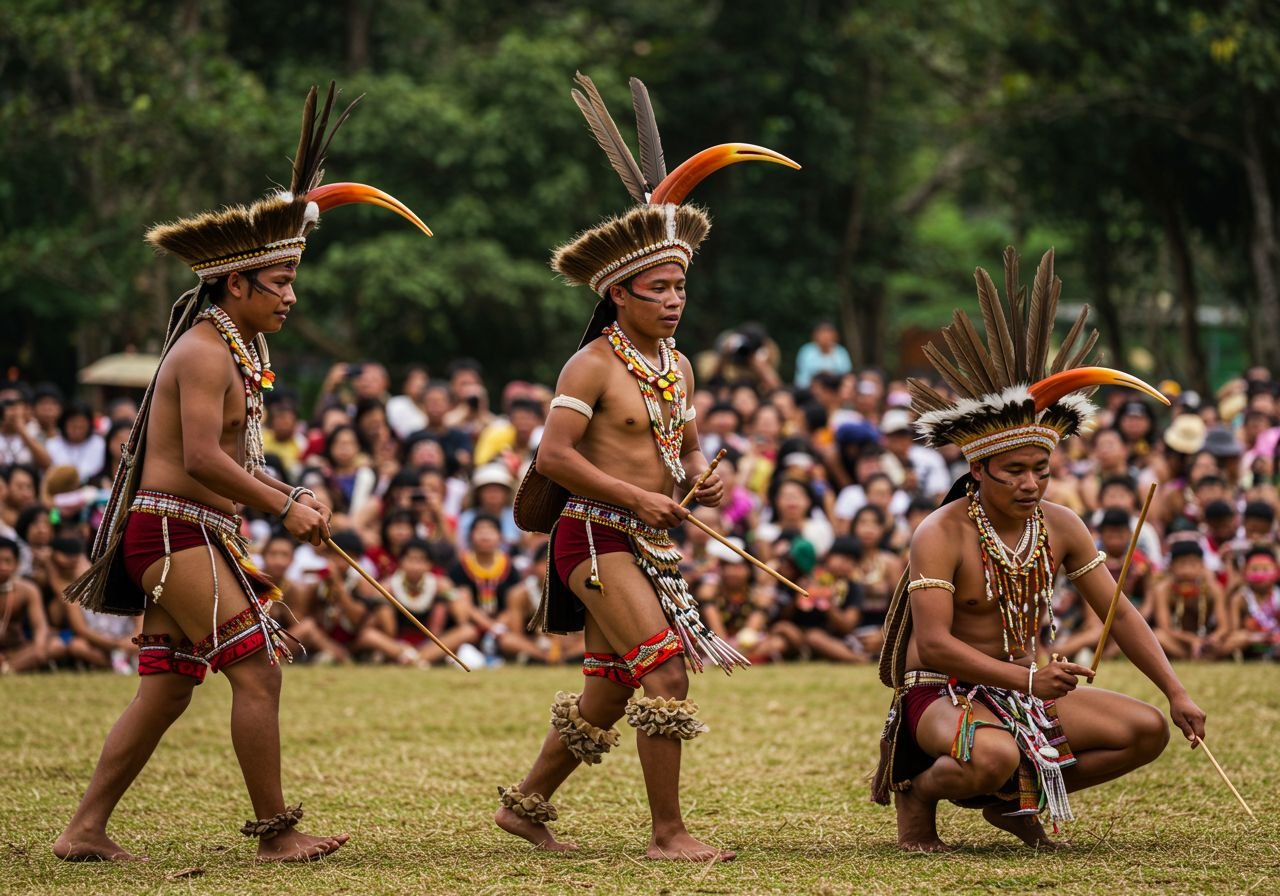
The hills of Nagaland do not merely host a party every December they undergo a total transformation that pulls the world into their orbit. At the centre of this shift is the Hornbill Festival in Nagaland, a relentless ten day surge of energy that serves as the definitive gateway to Naga culture. This is not a sanitised tourist display. It is a loud unapologetic and raw celebration of seventeen tribes that have guarded their customs for centuries. If you find yourself at Kisama Heritage Village in Kohima during the first week of December you are not just a spectator. You are standing in the middle of a living archive where the air is dense with the smell of woodsmoke and the ground shakes under the weight of rhythmic war dances.
The Cultural Roots of the Hornbill Festival in Nagaland
The history of the
Hornbill Festival in nagaland is relatively recent, yet its impact feels timeless. It was established in the year 2000 by the State Government of Nagaland with a very specific purpose. Before this, the Naga tribes celebrated their harvest and seasonal rites in their respective districts, often separated by formidable mountain ranges and distinct dialects. The government realised that to preserve this heritage and present a unified face to the world, a central platform was necessary. They chose the Great Indian Hornbill as the unifying symbol. This bird is a constant in the oral traditions and ceremonial attire of almost every Naga tribe, representing strength, alertness, and beauty. By naming the event after this bird, the state created a “festival of festivals” that effectively bridges the gap between ancient tribal boundaries and the requirements of modern tourism.
As one of the most significant cultural festivals in Nagaland the event has evolved from a modest local gathering into a massive global phenomenon.It acts as a massive cultural anchor for the younger Naga generation, many of whom are navigating the complexities of 21st-century life while trying to hold onto their ancestral roots.The timing is also deliberate. The festivities commence on 1st December to mark Nagaland Statehood Day ensuring that the celebration of culture is inextricably linked with the political identity of the state.Every year the opening ceremony at Kisama is a high-stakes production that sets the tone for the week featuring massed drums and a display of unity that is rare in such a diverse region.
Why this Ranks at the Top of Tribal Festivals in India
India is packed with celebrations but when people discuss tribal festivals in India,Nagaland’s premier event is usually the first one mentioned.The reason is simple it is the sheer intensity of the experience.The festival is hosted at the Kisama Heritage Village a permanent site designed specifically to represent a traditional Naga settlement.The heart of the village lies in the Morungs.These are traditional youth dormitories that were once the nerve centres of Naga villages where young men were taught the art of warfare, hunting and communal living.
At Kisama, each of the seventeen tribes has a dedicated Morung.These are not flimsy replicas.They are sturdy structures built with bamboo and wood, adorned with massive carvings of tigers,hornbills and human figures.The Konyak Morung is usually a focal point for visitors because of the tribe’s storied past as headhunters. You can see the detailed facial tattoos of the elders and the massive log drums that were once used to signal danger or victory. Meanwhile the Angami Morung showcases the sophisticated woodcraft and agricultural prowess of the Kohima district.
Each space provides an unfiltered look at a different way of life from the way the hearth is built to the specific patterns of the spears leaning against the walls.The authenticity here is palpable because these are not actors they are villagers who have travelled from the remote corners of the state to represent their kin.
Syncing Your Journey with the Hornbill Festival Dates
Success in visiting this part of the country depends entirely on your timing.The Hornbill festival dates are unchangeable running from 1st December to 10th December every year. Because the popularity of the event has skyrocketed, the best time to visit Nagaland is actually the final two days of November. Arriving early gives you the chance to settle into Kohima or the surrounding villages like Jakhama or Kigwema before the influx of thousands of tourists makes travel slow.
The weather during this period is a major factor. The days are usually sunny and clear with temperatures hovering around 18°C, but as soon as the sun dips behind the Barail range the temperature drops.It is not uncommon for nights to reach 3°C or 4°C so high-quality woollens and thermal layers are non-negotiable.
A Sensory Overload of Food and Music
If you think this is just about watching dances from a distance you are mistaken.The festival is designed to be interactive.One of the most talked-about events is the Naga King Chilli eating competition.The Naga Morich or Raja Mircha,is one of the hottest chillies on the planet. Watching brave souls attempt to chew these firecrackers while a crowd of hundreds roars with laughter is a quintessential part of the experience.If spice is not your thing the traditional wrestling matches provide a display of raw strength and techniques that are generations old.
The music scene here is equally diverse.While the daytime is overpowered by folk songs and the rhythmic thumping of log drums the nights belong to the Hornbill International Rock Contest.Nagaland has a deep-rooted love for rock and metal and this competition attracts some of the best talent from across Asia.The contrast between a tribal elder in full ceremonial regalia and a teenager in a leather jacket playing a Gibson Les Paul is exactly what makes modern Nagaland so fascinating.it is a place where multiple eras exist simultaneously without any sense of contradiction.
Authentic Flavours and the Art of the Loom
The food stalls at Kisama provide a culinary education that you cannot find in any cookbook. Naga cuisine is famously bold, relying on fermentation and smoke rather than a heavy use of oil or masala.One must try the smoked pork with Axone,which is a fermented soybean paste with a smell so pungent it can be detected from several metres away.For the locals it is the taste of home.For the visitor it is an acquired taste that eventually becomes addictive. This is also a place where you can sample Zutho, the local rice beer. It is served in large bamboo mugs and has a slightly tart,milky consistency that is incredibly refreshing after a long day of walking the hilly terrain of the heritage village.
Besides the food stalls the craft markets show the incredible skill of Naga weavers.The Naga shawl is much more than a piece of clothing.Each tribe has specific patterns that denote the wearer’s social standing or their achievements in battle or feast giving.Buying a shawl here means you are taking home a piece of a tribe’s social history. The beadwork is equally significant with necklaces made of carnelian,glass and bone that follow patterns established hundreds of years ago.
How Not to Be a Tourist at the Hornbill Festival
To get the most out of your trip to the Hornbill Festival you need to approach it with the right mindset.The Naga people are exceptionally hospitable but they also value their privacy and traditions. Always ask for permission before taking a close-up photograph of someone in their traditional dress.While the festival is a celebration the ceremonial gear they wear is often sacred or represents significant personal history.
It is also important to remember that Nagaland is a dry state though an exception is generally made for traditional rice beer within the festival grounds.Visitors should be mindful of local sentiments and maintain a level of decorum.The terrain is physically demanding so
wear sturdy boots with good grip.The paths between the Morungs are steep and can be slippery if there is a light morning mist.Bringing a reusable water bottle is a great way to reduce the plastic footprint on these pristine hills as waste management in remote mountain areas is a constant challenge.
The journey into the Naga hills is a life-changing event for those who crave depth and authenticity. It is a place that demands you leave your preconceived notions at the door and embrace a different type of life. Many festivals can be observed from the sidelines, reduced to performances and photographs. Travelling with Meraki Diaries turns the Hornbill Festival into something far more immersive, placing you inside the traditions, flavours, and stories that define Nagaland until the experience leaves a lasting mark.
If you are a woman looking to experience this cultural phenomenon in a way that is safe, thoroughly planned, and fully engrossing, the
Meraki Diaries‘
women-only Kaziranga and Nagaland tour is the ideal way to do it.This journey takes the stress out of the complex logistics and permit requirements, allowing you to focus entirely on the war cries, the rice beer, and the incredible wildlife of the neighbouring Assam plains.