
The blossoms are only the beginning.
There is sake brewed in the same valley for centuries. There are traditional tea ceremonies held in homes steeped in history. There are kimono, ikebana, tatami dining and conversations with women who have dedicated their lives to preserving Japanese cultural traditions.
That is the difference between seeing Japan and experiencing it.
A women only Japan tour creates space for that deeper experience. With a small group, thoughtful pacing and experiences chosen beyond the usual tourist circuit, the journey becomes less about ticking places off a list and more about understanding the culture around you.
That is the kind of travel Meraki Diaries was built to create.
Most cherry blossom Japan itineraries follow a familiar pattern. A few days in Tokyo, followed by Kyoto and Osaka, perhaps a stop near Mt. Fuji, with photographs at the country’s most famous landmarks.
There is nothing wrong with travelling this way. Japan is extraordinary on any itinerary.
But there is another side to Japan that many visitors do not get to experience. It is found in smaller cultural encounters, traditional practices and conversations that require time rather than a quick stop between attractions.
That is where the design of a trip matters.
A boutique women-only group of ten, travelling with a local female guide and a Meraki tour leader, allows us to travel differently. We can slow down, spend longer in meaningful places and choose experiences for their cultural value rather than simply their popularity.
The result is a Japan trip built around depth.
In the hills outside Tokyo, beside the Tamagawa River, sits Ozawa Shuzo, a sake brewery with a history dating back to 1702.
It is a world away from the busy streets of central Tokyo.
We spend a morning learning about sake, the brewing process and the importance of the mountain water used in its production. There is time to taste, ask questions and appreciate a tradition that has continued across generations.
This is the kind of experience that can easily be missed when a Japan itinerary is built around only the major tourist attractions.
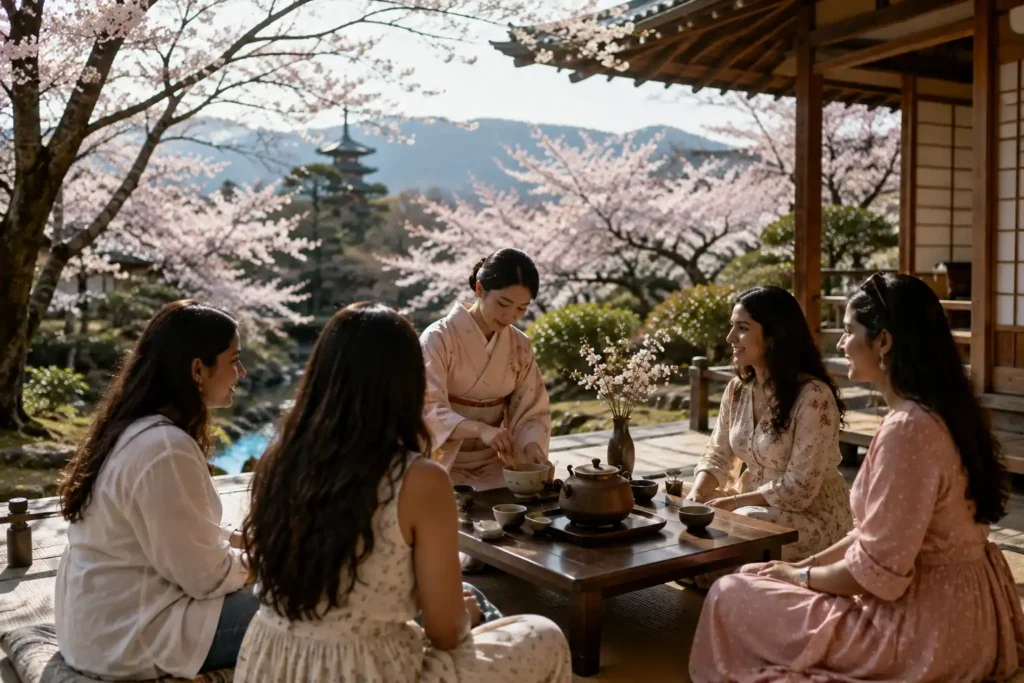
In Kyoto, we dress in traditional kimono and participate in a Japanese tea ceremony in a historic home.
The ceremony is not simply about drinking tea. It is about presence, precision and the quiet rituals that surround the preparation and serving of matcha.
The experience begins before the tea is even served. Being dressed in a kimono, feeling the weight of the fabric and adjusting to the deliberate movements of traditional dress changes the way you experience the ceremony itself.
There is no need to rush through it.
For a few hours, the outside world can wait.
Geishas are among the most recognisable and misunderstood figures in Japanese culture. For many visitors to Kyoto, seeing one from a distance in Gion is as close as they get.
Our itinerary allows for something more meaningful: a conversation and an opportunity to learn directly about the traditions, discipline and artistic practices that shape this world.
It is very different from reading about geishas in a guidebook or watching a documentary.
The value lies in being able to listen, ask questions and encounter a part of Kyoto’s cultural heritage through conversation.
Lake Ashi sits within the volcanic landscape of Hakone and offers one of the most beautiful ways to experience the region.
We take a first-class cruise across the lake, with views towards Mt. Fuji when the weather is clear. The Hakone Shrine’s famous red torii gate rising from the water adds another layer to the landscape.
It is not simply about getting the perfect photograph.
It is about slowing down enough to appreciate the landscape.
Ikebana, the Japanese art of flower arrangement, is about far more than arranging flowers beautifully.
It is a practice built around balance, form, asymmetry and negative space. The empty space between elements matters as much as the flowers themselves.
We take part in a private, guided class where we create our own arrangement rather than simply watching a demonstration.
It is a quiet experience, but that is precisely what makes it memorable. You leave having made something yourself, while also gaining a small window into the Japanese approach to aesthetics and simplicity.
An onsen is one of those experiences that is difficult to understand until you have actually experienced it.
Japanese bathing culture places enormous value on slowing down, stepping away from everyday routines and allowing yourself to simply be present.
We visit an onsen in Osaka towards the latter part of the journey, when the group has already spent several days travelling together.
By then, the experience is not just about the hot springs. It becomes another shared moment in a journey that has gradually brought ten women closer together.
At least one meal on our Japan trip is enjoyed in a traditional setting, seated at a low table in a tatami room.
The food is, of course, part of the experience. But the surroundings matter too.
The woven tatami, sliding shoji screens, careful presentation and slower rhythm of the meal create a completely different atmosphere from a conventional restaurant.
Travel is often about understanding a place through its everyday rituals. Food is one of the most intimate ways to do that.
This is the experience everyone imagines when they think about visiting Japan during sakura season.
But a proper hanami is about more than standing beneath a cherry tree for a photograph. The Japan National Tourism Organization describes cherry blossom viewing as a long-standing Japanese tradition, with people gathering to enjoy the blossoms, food and the atmosphere of spring.
We bring food, find a beautiful setting and take our time beneath the blossoms. We sit together, talk, eat and watch the petals move in the breeze.
By this stage of the journey, the group has already shared several days of experiences. The picnic therefore becomes more than a beautiful stop on an itinerary.
It becomes a celebration of the journey itself.
Our Tokyo experience is led by a local female guide who can offer something that a guidebook cannot: context.
She knows the places worth spending time in, the cultural details visitors often miss and the small social nuances that make navigating Japan more comfortable and interesting.
Having a female guide also adds a different dimension to the conversations that happen throughout the journey.
Our Meraki tour leader from India travels with the group as well, giving you the combination of local knowledge and the familiarity of someone who understands how we like to travel.
Japan is an incredible destination for women travellers. But safety is only one part of why a women-only group can be meaningful.
The bigger difference is the group dynamic.
When ten women travel together, supported by a local female guide and a Meraki tour leader, there is a natural sense of shared experience. Conversations become part of the journey. People begin travelling not simply alongside one another, but with one another.
A tea ceremony feels different when you have friends to discuss it with afterwards.
A Geisha conversation becomes something you continue talking about over dinner.
And a picnic beneath the cherry blossoms means something different after several days of shared experiences.
That is the real value of a women-only trip. It creates the space for connection alongside discovery.
Cherry blossom season is one of the most beautiful times to visit Japan, but it is also one of the least predictable. According to the Japan National Tourism Organization, warmer parts of Japan begin seeing cherry blossoms in late March, with Tokyo generally reaching bloom around the end of March. Kyoto and Osaka follow a similar timeline, although exact dates vary from year to year.
That is why we do not want the entire trip to depend on one morning, one park or one photograph.
Our cherry blossom Japan tour is planned around the late March to early April window, with the route designed to give us multiple opportunities to experience sakura across the journey.
We monitor forecasts as the departure approaches and build flexibility into the itinerary wherever possible.
Because the goal is not simply to see cherry blossoms.
It is to experience Japan during one of its most beautiful seasons.
There are many ways to travel through Japan.
You can move quickly between the major cities, visit the famous landmarks and collect the photographs everyone recognises.
Or you can slow down.
You can drink sake beside a river in Okutama. Wear a kimono in Kyoto. Learn ikebana. Sit on tatami. Speak with a Geisha. Cruise across Lake Ashi. Soak in an onsen. Share a picnic beneath the cherry blossoms.
None of these experiences, on their own, defines Japan.
Together, they create a much richer picture of it.
That is what we mean when we call this an immersive journey.
It is not about seeing more.
It is about experiencing more deeply.
You can enquire through the Meraki Diaries Japan tour page. Our team will share the itinerary, inclusions, pricing and booking details with you. The group is limited to ten women.
Indian passport holders travelling to Japan for tourism generally need the appropriate visa before travel. The Embassy of Japan in India provides the latest visa requirements and application information, including details on submitting applications through VFS. Meraki Diaries can also guide travellers through the process as part of the trip planning.
A cherry blossom season in Japan can give you beautiful photographs.
But the right journey can give you something more lasting.
A conversation you keep thinking about. A traditional ritual you finally understand. A quiet morning beside a river. A meal around a low table. Flowers arranged with your own hands. Ten women who began the journey as strangers and returned with stories they will continue telling long after the petals have fallen.
That is the Japan we want to share.